In Joseph Campbell's revolutionary 1949 book,
The Hero with 1000 Faces, he described a basic pattern that every "hero" follows in a story. This isn't to say that all stories follow this pattern, however when considering a character as an individual, you can probably apply this model to their life in many ways. Also, the journey is not a one time adventure. The hero's journeys are cyclical, repetitious, and occur on different time scales. A journey can transpire over the course of a lifetime, or a year, or even in a single 45 minute episode of Mad Men. A single 'challenge' or 'temptation' could be considered a journey in itself or a journey within a journey.
Don Draper is clearly the main 'hero' of Sterling Cooper (...Draper Price). The pilot episode of the series introduces us to Don's suave brilliance, pure talent, infidelity, and drinking tendencies that comes with his job. Don Draper conducts himself in a way that makes his presence known when he walks into a room. He's the boss; the Don; the King.
One element not included in the model below, but a commonality in hero myths according to Campbell is a miraculous birth. Don's birth story is only mentioned twice. Once in a flashback that showed a baby left on a door stoop. Secondly, Don told a client (Heinz Beans) that he was "like Moses... a baby in a basket."

As I said before, these journeys are cyclical and therefore there isn't a "correct" answer to any of these elements of the journey. However, you can certainly point to an element when you see it. For example, maybe Don's "Call to Adventure" to become an ad man came when he was working in a fur shop, and Roger came in to buy a fur scarf. Don recognized Roger's importance as a business man and chewed his ear enough to get a lunch meeting with him. Roger later hires Don after having a few too many drinks and he doesn't realize he's hired him until Don shows up at the office the next day. They show this flashback when Don drinks too much and pitches to Life cereal the catch line "The cure for the common breakfast" which Peggy reveals is the line of a young (talentless) copywriter, and Don is forced to hire him. The point of the parallelism shows a call, or a beginning to an adventure of their careers.
As mythology relates to the human condition we see that the model is based on the human brain in that there is the known realm (the conscious) and the unknown or subconscious realm. For Don there are infinite number of known and unknown realms. The known vs. the unknown are simply opposites in lifestyles, time periods, or settings. Therefore the 'known' could mean when Don is sober, and the 'unknown' could be when Don is drinking. Or perhaps it's home life vs. work life. Married vs. Divorced. Fidelity vs. cheating. Dick Whitman vs. Don Draper. Again it shows that these journey's aren't acutely defined.
While the journey's are abstract cycles, Don takes an epic journey that extends over the first 5 seasons of Mad Men. I will do my best to illustrate it below.
Call to adventure: Don's call to adventure occurs in the very beginning when he pitches to Lucky Strike after new Tobacco legislation and their ad campaign needs to get around it. This could be a hero's journey in itself in the meeting when Pete tries to pitch a terrible idea and Don saves the day. However he proves his worth to Lucky Strike, Sterling Cooper, and the viewers ensuring all of us, he can be our hero.
Supernatural aid: Don is gifted with natural talent and confidence. Enough said.
Helper: While any hero has many helpers, Peggy is clearly Don's favorite. Other helpers are Pete, Lane, Roger, Bert, Sally, Betty (maybe), and Joan.
Mentor: Roger could be seen as a mentor to Don, but also Bert Cooper helps Don significantly in many ways. Bert gives Don more career advice, like the episode when he told Don he could be one of the "chosen few". But Don appreciates Roger because he's the type of guy that Don wants to be when he's that age; an important business man who never really slowed down living the life of luxury. Anna is probably his biggest mentor because she is the only person in the world who really knew him, as Don once said.
While these all could be considered Don's mentors, Don is definitely Peggy's mentor. This model doesn't necessarily apply to only men. Dorothy from The Wizard of Oz is one of the best examples of a character on the Hero's Journey. Peggy is on a journey of her own. Author Maureen Murdock wrote a book based on Joseph Campbell's teachings called the
Heroine's Journey, which presents a different model for Women.
However, Campbell's archetypal journey can transcend the gender line.
Challenges and Temptations: (The entire show) Each episode produces a daily challenge in Don's work or personal life. We see Don's transformation from a cheating husband with Betty to a loyal man to Megan (at least for a while). Hero's tend to fail challenges and fall into temptations along their journey but hopefully they learn from their mistakes over time.
Abyss: It's quite clear that in Season 4, Don's life takes a turn for the worst and he goes to a very dark place. He begins to drink too early and often in the day. His falls to temptation finally catch up with him and ruins his marriage and forced him into a divorce. He sleeps with his secretary and jeopardizes her job. He slides deeper and deeper into his abyss until he hits rock bottom in the episode he keeps Peggy at work late on a Friday when her boyfriend Mark planned a surprise dinner for her. Peggy breaks up with her boyfriend over the phone before being yelled at by Don. This is the same night of the famous Sonny Liston vs. Muhammed Ali fight when Don bet $100 on Liston; Ali knocked him out and made the cover of ESPN 50 years later. Even after listening to the terrible fight in a bar, Don tells Peggy "Let's go someplace darker." At the end of Don and Peggy's late night bender, Don receives word that his beloved Anna finally died of cancer. Don cries in his office.
Rebirth: Don's rebirth happens when he writes the letter to himself that begins "They say as soon as you have to cut back on your drinking, you have a drinking problem."
Transformation/Atonement: He begins to acknowledge how his excessive living has affected him, and he takes steps to make it better. He tells Megan to stop him at 3 drinks so he doesn't over do it. Moreover, he goes through the same situations he used to go through with a new perspective. He goes to a whore house and stays outside while Pete and some others have their fun. In the cab ride home Pete criticizes Don for being no fun and Don tells him that if he had "met Megan first, I would have known not to throw it all away."
Return: The Season 5 finale Don acts as a loving husband to Megan and allows her to be the girl on a client's commercial shoot. Wearing all black he walks straight off of the shoot to a bar and orders an Old Fashioned, a drink that he hasn't had since before his first divorce. The season ends in a delightfully dark Don Draper smile, to a lady of the night. Despite his previous journeys, he's still Don Draper.
Don's journey is one of many journeys in the show. There are significant and note worthy journeys for many other characters; Pete, Peggy, Roger, Sally, Betty, Ken Cosgrove, Sal. This model is EVERYWHERE and is applicable to many different characters many different times.


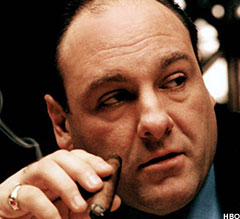

 We can thank Matthew Weiner for this. Weiner won nine Primetime Emmy Awards for his writing on both Mad Men and The Sopranos. Weiner is head-writer and creator of Mad Men. Weiner finished his work on The Sopranos in 2007, the same year Mad Men debuted on AMC. Weiner used the mobster-murderer, Tony Soprano, as the mold in which to cast his new character, Don Draper. Draper became the stage on which Weiner's evil writing could dance. He can cheat, drink, and verbally abuse anyone he pleases upon his throne as creative director. Weiner imagined Don Draper as America, but I see him more as the corrupt King of the states, if we were a monarchy.